
The Glaucous Macaw was one of South Americas large parrots. This beautiful bird attracted attention through its distinctive blue-green feathers. However, its population declined because of several human activities.
Today, researchers consider this species possibly extinct in the wild. The disappearance of parrots highlights the importance of protecting parrots. Understanding the history of parrots helps explain wildlife conservation challenges.
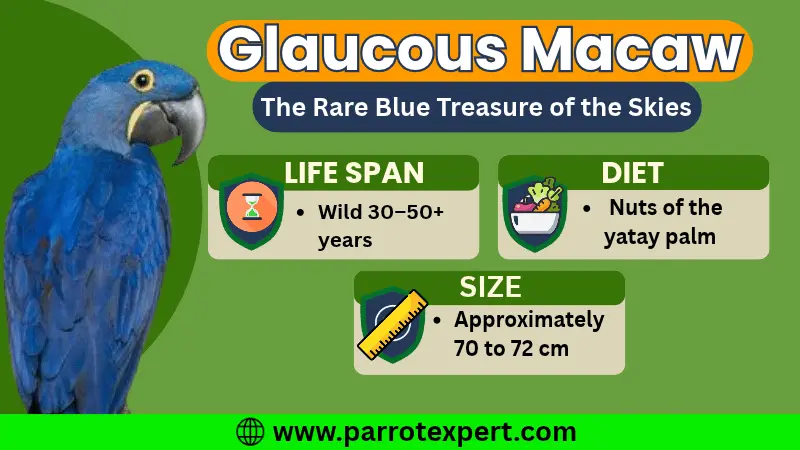
Let us explore the appearance of parrots, the habitat of parrots, the diet of parrots, the behavior of parrots and the extinction status of parrots.
What Is a Glaucous Macaw?
The Glaucous Macaw belongs to the parrot family. Its scientific name is Anodorhynchusglaucus, identifying its classification. This species originally lived across parts of South America. Naturalists described its distinctive appearance during earlier centuries.
Moreover, it belonged to the group of blue macaws. This group includes several other remarkable South American parrots. However, the Glaucous Macaw became extremely rare during history.
Read More: Lear’s Macaw: Lifespan, Diet, Size, Conservation Status, & Facts
The bird measured approximately 72 centimeters from head to tail. Its feathers had green-blue and turquoise colors. The head also had a grey-green tint all over. On the throat, the feathers were grey and brown in pattern. Its strong beak was grey or black. Yellow skin ringed its eyes and the lower part of its bill. These features created its distinctive appearance among large parrots.
Glaucous Macaw Appearance and Physical Characteristics
The Glaucous Macaw appearance made this species particularly interesting. Its feathers combined blue, green, and greyish shades. Unlike some macaws, its underparts appeared somewhat greener.
The bird had a head and neck that were a greenish grey. Its throat feathers were darker, standing out against the feathers on its body. It also had a curved beak. This powerful beak helped crack tough palm nuts. Its yellow eye ring created another recognizable feature.
Read More: Chestnut Fronted Macaw: Lifespan, Diet, Size, Habitat & Facts
The eyes themselves displayed a brownish appearance naturally. Historical descriptions provide most information about its appearance. Unfortunately, scientists cannot study living wild populations today.
Glaucous Macaw Size and Weight
The Glaucous Macaw was a relatively large parrot species. Historical references report approximately 72 centimeters in length. This measurement includes its long, impressive tail feathers.
Read More: Red Fronted Macaw: Lifespan, Size, Diet, Care, Price and Facts
However, reliable information about its body weight remains unavailable. Researchers cannot give an average weight today. The parrots large size helped distinguish the parrot from parrots.
Additionally, the parrot’s strong beak supported the parrot’s natural feeding habits. Like other macaws, it likely possessed powerful flight abilities. However, detailed behavioural observations remain extremely limited today.
Glaucous Macaw Habitat and Natural Distribution
The Glaucous Macaw habitat included several South American regions. Historical records connect this bird with Argentina, Brazil, and Uruguay. It lived near major rivers and surrounding grasslands.
These regions included the Paraná and Uruguay River systems. I have read old records that mention Paraguay’s surrounding landscapes and Paraguay’s hills and rivers are often described in these documents.
Read More: Blue Throated Macaw: Habitat, Lifespan, Diet, Care, & Facts
The bird preferred lightly wooded grasslands and palm-rich areas. It also inhabited marshes and riverside vegetation zones. Moreover, scattered palm trees provided important feeding opportunities.
Researchers particularly associate it with yatay palm trees. These palms produced nuts that supported its natural diet. Unfortunately, settlement gradually changed many original habitats.
Glaucous Macaw Diet and Feeding Habits
The Glaucous Macaw diet mainly included native palm nuts. Researchers believe yatay palm nuts formed important food. These nuts supplied energy through natural fats and nutrients. Its strong beak was a help for cracking open those tough outer shells. That way, the bird could get to the bits inside.
Read More: Great Green Macaw: Lifespan, Size, Diet, Care, and Facts
How it ate was likely a lot like big macaws. Still, scientists do not have clear information about everything it ate. Researchers cannot confidently list every consumed plant species.
Nevertheless, historical evidence strongly supports palm nuts as food. Protecting native palm trees therefore remains important conservation knowledge.
Glaucous Macaw Behavior and Social Life
Researchers believe Glaucous Macaws probably lived in social groups. Like other macaws, they may have formed strong pairs. Their natural environment offered suitable feeding and nesting areas. Moreover, social behavior probably helped birds find food. Yet scientists do not have records of how birds communicated.
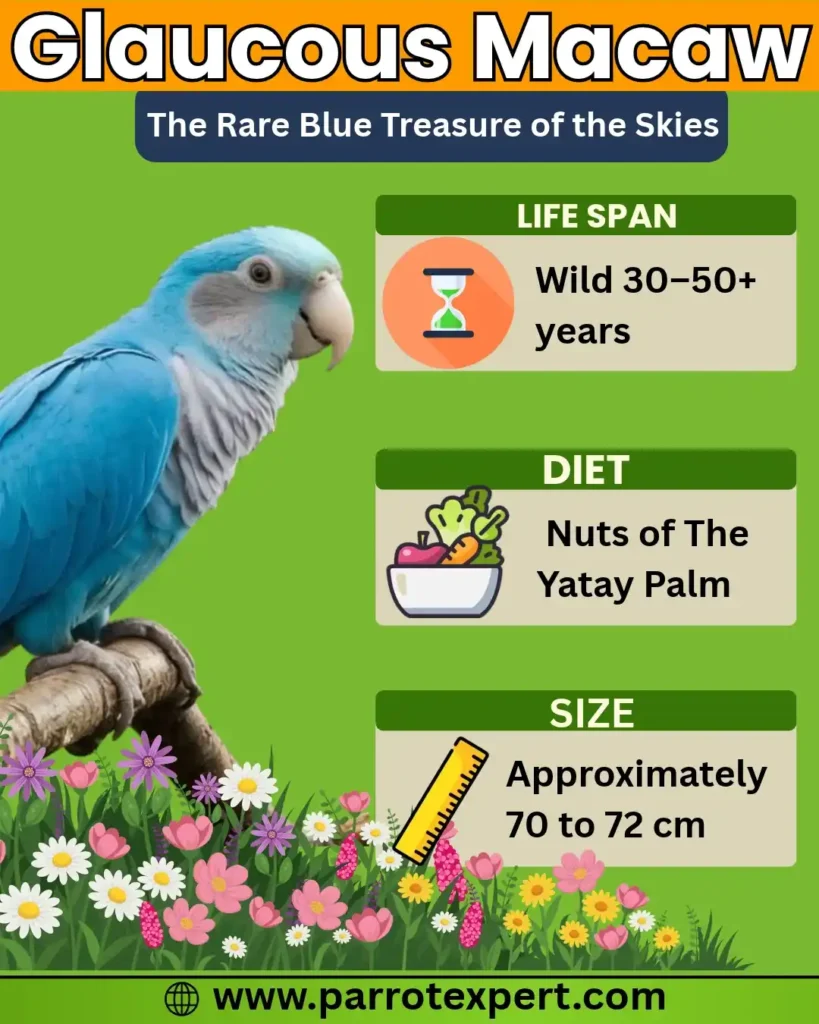
We find it interesting that historical records give insight into nesting behavior. Some researchers think cliffs and steep banks might have been chosen as sites. Tree cavities could also have provided places for nesting. However, scientists cannot confirm their complete breeding patterns. Their clutch size and incubation period remain unknown.
Glaucous Macaw Extinction Status
The Glaucous Macaw extinction status remains an important conservation concern. The World Parrot Trust lists this species as possibly extinct. Its IUCN category remains Critically Endangered (Possibly Extinct).
Read More: Military Macaw: Lifespan, Size, Diet, Care, Price, & Facts
Researchers have not confirmed reliable wild sightings recently. The last likely observations date from the late 1990s. However, some historical reports suggested possible later sightings. Only two acceptable twentieth-century reports received serious attention.
One direct observation occurred in Uruguay during 1951. Another report came from Paraná during the early 1960s. Researchers also searched historical habitats during later conservation projects. Unfortunately, those surveys found no confirmed living populations. Therefore, scientists fear this species has disappeared completely.
Why Did the Glaucous Macaw Become Extinct?
A lot of what people do has made the numbers go down. When we understand these dangers, we can see why the species would be gone. I see the drop in numbers happens because of what we do and the drop in numbers is an outcome of our actions. Extinction may be the result.
1. Habitat Destruction
Human settlements grew bigger. Spread out over the bird’s natural home. Farming also changed grasslands and river areas. As a result, good places for the birds to find food and build nests became harder to find.
2. Hunting and Capture
In the past, people hunted macaws to get their feathers. Bird collectors also caught parrots to sell them. This made things even harder for the birds, because the birds were already falling in number. I remember hearing about this. It makes me sad.
3. Loss of Native Palm Trees
Palm trees that grow sideways gave us a source of food from nature. Habitat changes reduced access to these valuable feeding areas. Therefore, the bird gradually lost important ecological resources.
4. Small Remaining Population
The species became increasingly rare during the nineteenth century. Consequently, isolated birds faced greater difficulties finding suitable partners. This situation probably increased their long-term extinction risk.
Glaucous Macaw vs Hyacinth Macaw
Many bird enthusiasts compare the Glaucous Macaw with Hyacinth Macaws. Both belong to the Anodorhynchus genus of macaws. Yet, their appearance and conservation circumstances differ considerably.
Read More: Green Winged Macaw: Lifespan, Diet, Care, Size, Price, & Facts
| Feature | Glaucous Macaw | Hyacinth Macaw |
|---|---|---|
| Scientific name | Glaucus | Hyacinthinus |
| Main color | Blue-green | Deep cobalt blue |
| Size | Approximately 72 cm | Approximately 100 cm |
| Habitat | Southern South America | Central and eastern South America |
| Diet | Mainly yatay palm nuts | Various palm nuts and fruits |
| Conservation status | Critically Endangered (Possibly Extinct) | Vulnerable |
The Glaucous Macaw displayed greener shades throughout its plumage. Meanwhile, Hyacinth Macaws feature striking deep blue feathers. Additionally, Hyacinth Macaws still maintain wild breeding populations. However, the Glaucous Macaw has no confirmed living population.
Interesting Facts about the Glaucous Macaw
- The scientific name of this parrot is Anodorhynchusglaucus.
- It had a total length of around 72cm.
- It was green, blue and grey.
- Its natural diet was most likely made up of Yatay palm nuts. It historically inhabited parts of southern South America.
- Researchers consider the species possibly extinct in the wild.
- Its last captive specimen died during 1938.
- Its historical decline involved habitat destruction and hunting.
FAQs (Frequently Asked Questions)
Verdict Up
The Glaucous Macaw remains an important symbol of wildlife conservation.Its lovely look once drew eyes over South America. However, hunting and habitat destruction have severely lowered the populations of species.
Today, researchers think this amazing parrot may be gone for good. Its past is a lesson for all of us about keeping places safe.Also, work to save nature can help kinds of macaws that are at risk of dying out.
Every responsible wildlife protection action helps preserve biodiversity. Also helps strengthen ecosystems. Studying birds that are gone can help stop animals from disappearing later on.
If this article is valuable for you, then please share it along with your friends, family members, pet lovers or relatives over social media platforms like as Facebook, Instagram, LinkedIn, Twitter, and more.
Do you have any experience, tips, tricks, or query regarding on this? You can drop a comment!
Have a Nice Day!