
Among the world this blue throated macaw is rarest and extremely beautiful parrot species. Its bright feathers, intelligent behavior, and distinctive throat this qualities make this bird very captivating.
Nonetheless, this type of remarkable species have to face serious challenges in its natural environment. Conservation organizations now work hard for protecting their habitat and support breeding.
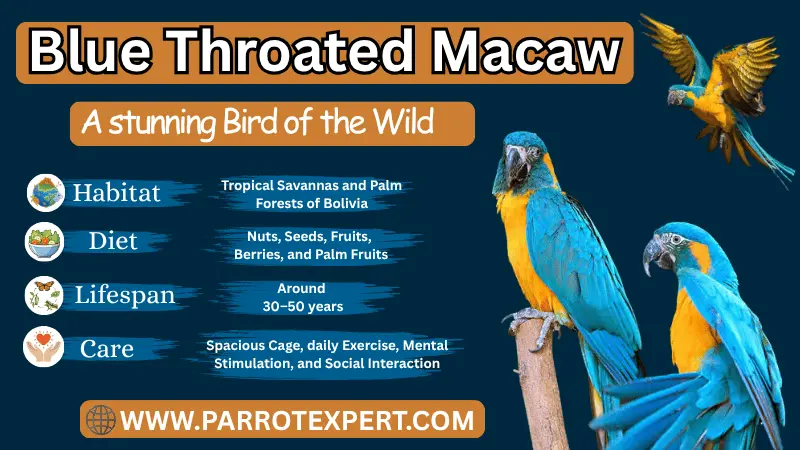
In this article, we studying the blue throated macaw species in which include their appearance, behavior, diet, lifespan, and their endangered status. You will also study about where they lives and how conservation organization efforts helps them.
What Is a Blue-Throated Macaw?
The blue-throated macaw is belongs to a large species of parrot and they are naturally habitat in Bolivia. All birds have their scientific name as well Blue-Throated Macaw scientific name is Ara glaucogularis. Bird admires known them as the blue throat macaw or call them Wagler’s macaw.
Read More: Great Green Macaw: Lifespan, Size, Diet, Care, and Facts
This species has a bright yellow underparts and attractive beautiful blue-green upper wings. It has a most recognizable feature that is the vivid blue patch beneath its beak. And in addition it has a long tail and powerful curved beak that create an impressive or distinct look.
They have feet that are too strong they help them to climb branches. Even they have curved strong beaks they can open tough fruits and palm nuts. Like other parrots, they also communicate through the loud calls and social interactions.
You usually see these intelligent birds living in pairs or small groups. They may also gather with other macaw species around feeding areas.
Scientific Name and Physical Characteristics
The blue-throated macaw have a scientific name i.e. Ara glaucogularis. This scientific name can help scientists to determine the species are related macaws.
Adult blue-throated macaws typically measure it’s from 75 to 85 cm in length, including their tails. Along with bright yellow plumage they have their vibrant bodies blend turquoise-blue feathers.
Read More: Military Macaw: Lifespan, Size, Diet, Care, Price, & Facts
Meanwhile, dark feathers around their faces create an attractive facial pattern. Additionally, they have curved, strong and large beaks through which they can crack for own tough plant foods and palm nuts.
Both sexes look similar, making visual identification difficult for inexperienced observers. Along with their distinct throat coloration distinguish them apart from other large parrots.
Blue-Throated Macaw Habitat
We learned about the throated macaw. The blue-throated macaw is native, to Beni. Beni is an area of Bolivia. Furthermore, this region has flooding grasslands, palm trees, forests. The blue-throated macaw relies on palm trees strongly for food. The blue-throated macaw relies on palm trees strongly for nesting.
We have seen the blue‑throated macaw perched on raised forest islands. The blue‑throated macaw likes to stay high above the grasslands that surround these islands.These islands shield the blue‑throated macaw from the floods that sweep the plains. In addition rivers and gallery forests near these islands give the blue‑throated macaw places to eat and to roost.
Palm trees provide fruit, nesting cavities and suitable resting spots for the macaw. Therefore protecting palms is essential, for the survival of the blue‑throated macaw.
Macaw BlueThroated Diet & Feeding
Blue-throated macaws enjoy a diet of fruits, seeds, nuts and other plant matter. Palm fruits provide particularly important nutrients throughout their natural habitat. They may also consume fruit pulp and liquids from certain palm fruits.
Read More: Green Winged Macaw: Lifespan, Diet, Care, Size, Price, & Facts
We think birds have beaks that help birds break open hard food coverings. For now birds feet allow birds to hold food while eating. As food availability changes with the seasons, so birds may move between different feeding locations.
Their powerful beaks help them break open hard food coverings. Meanwhile, their feet allow them to hold food while eating. They may travel between feeding locations as seasonal food availability changes.
We think that when these birds are kept in captivity these birds need diets that are made for large parrots. These birds should be fed by owners who talk to veterinarians about suitable food and nutrition for these birds. We know that a varied diet helps support feathers, strong bones and normal activity, for these birds.
BlueThroated Macaw Lifespan
We think the blue‑throated macaw lifespan can be than thirty years if the conditions are right. In captivity some blue‑throated macaws may live forty to fifty years. The blue‑throated macaw lifespan changes with genetics, food, vet care and the environment.
Read More: Cuban Macaw: Lifespan, Size, Extinct, Sale, and Facts
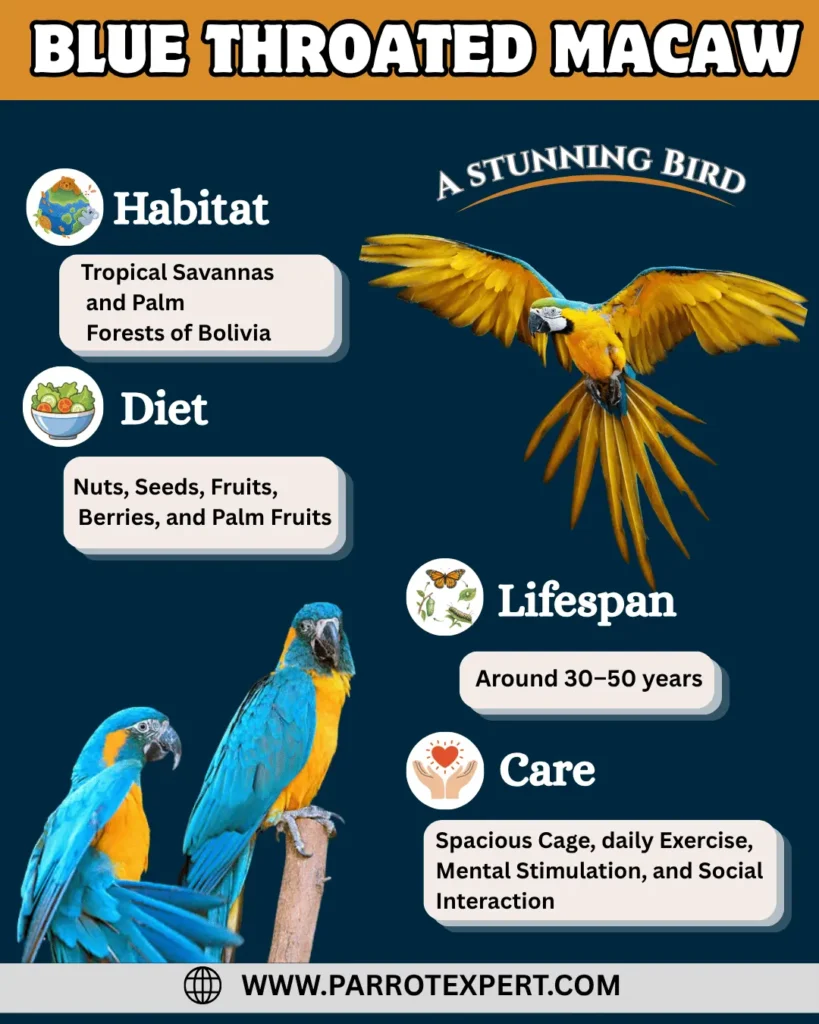
We think scientists have a little data about the blue‑throated macaw lifespan in the wild.Blue‑throated macaws, in the face predators, food shortages and habitat disturbance.We believe that good care can help blue‑throated macaws stay healthy during their lives.
In captivity blue throated macaws need lots of space and things to do every day.Blue throated macaws also need people to interact with them and checkups from a vet.Blue throated macaws also need food that’s good, for them and that gives them all the nutrients they need.
Why Is the BlueThroated Macaw Endangered?
The blue throated macaw is endangered for a key reason. A time ago people caught them illegally to sell as pets. Because they are rare and have beautiful feathers some collectors wanted them badly. This caused their numbers to drop fast. Their homes are also disappearing. People cut down palm trees for firewood.
To build things sometimes people burn grasslands, which hurts the areas where birds nest and where young palm trees grow. They also have to fight for space to nest. Other animals use the tree holes and predators can attack their eggs or chicks.
Read More: Hyacinth Macaw Parrot: Species, Size, Lifespan, Diet, and Facts
Because, there are a few blue throated macaws left any small problem can make it hard for blue throated macaws to increase in number. Chicks are especially at risk. They can get sick be infected by parasites or be harmed by changes in the weather or other dangers, in nature. All of these things together make it very hard for the blue throated macaw to survive and recover.
For the blue throated macaw to bounce back. Conservation groups now protect nesting areas and monitor wild populations. They also install nest boxes and support carefully managed breeding programs. Our work seeks to boost breeding success And It also seeks to strengthen populations.
Where Does the Blue-Throated Macaw Live?
The blue‑throated macaw naturally lives in the Llanos de Mojos region. The Llanos de Mojos region is part of Bolivia’s Beni Department in South America. Wild blue‑throated macaw populations live in a limited area.
Unlike other parrots that live in many countries the blue‑throated macaw does not live in many countries. Because the blue‑throated macaw has a range protecting its habitat is very important, for its long‑term survival.
How Many Blue Throated Macaws Are Left in the World?
The question “how many blue throated macaws are left in the world” shows how rare the throated macaw is. The World Parrot Trust says there are 208 to 303 blue throated macaws left in the wild. That count only includes adult blue throated macaws, not every blue throated macaw.
Read More: Severe Macaw: Lifespan, Size, Care & Diet, Price, and All Facts
Population numbers can shift when researchers run surveys or find new blue throated macaw groups. So readers should see these figures as estimates rather than exact counts.
Even though conservation work has helped a bit the blue throated macaw is still very vulnerable. Protecting its habitat and helping blue throated macaw chicks survive are tasks.
Blue Throated Macaw vs Blue and Gold Macaw
A comparison of the blue throated macaw and the blue and gold macaw shows differences. Both birds have upper feathers and yellow underparts. The blue throated macaw and the blue and gold macaw differ in throat marks in the places where the blue throated macaw and the blue and gold macaw live and in how threatened the blue throated macaw and the blue and gold macaw are.
The blue throated macaw displays a patch, on the throat of the throated macaw. The blue and gold macaw shows a black throat area. Blue and gold macaws also occupy an area across South America. Blue-throated macaws live in a small or limited area of Bolivia.
That limited range makes the blue throated macaw more at risk from habitat changes. In contrast, blue and gold macaws is a type of parrots that are inhabit environments throughout the continent.
The blue-throated and the blue-and-gold macaw are two type of parrots both requires unique habitats for living, enrichment activities, and professional veterinary attention. These both birds are not ideal for people that are seeking a low-maintenance pet.
Blue Throated Macaw for Sale & Price
People regularly searching online for a blue-throated macaw that is for sale. They may also search for the price of a throated macaw before buying. But because the blue throated macaw is rare and trade rules are strict this bird is very sensitive.
Read More: Can Macaws Talk? Exploring Macaw Vocalizations
There is no price for the blue throated macaw because how many are available and what the law says changes. Any listed price should make buyers wonderabout where the bird came from and if it’s legal. Buyers should never buy a throated macaw that was taken illegally from the wild.
CITES Appendix I limits trade of the throated macaw. Before thinking about owning one contact wildlife officials and qualified bird experts. Only purchase a macaw when you verify the papers that they are valid and confirm it comes from a trusted and reliable breeding facilities.
Conservation Efforts to Protect Them
Conservationists protect palm orchards and nesting making regions across Bolivia. They also put up nest boxes where natural tree holesre rare. Researchers watch how blue throated macaws breed. They study what problems young blue throated macaws face. Breeding programs can help with reintroduction plans.
The blue throated macaw will recover only if its wild habitat is protected. Local people and landowners also helps for keeping the blue-throated macaw safe for the term. People can help by not buying wildlife products and by supporting groups. Distributing information also increases awareness regarding the macaw. The throated macaw is a parrot species that is critically endangered.
FAQs (Frequently Asked Questions)
Bottom Words
The Blue throated macaw is a parrot species with the property of exceptional colors and intelligence. However trapping and habitat loss once brought it close, to extinction. Currently places that protect animals give hope even though the species is still very close to disappearing.
Read More: Blue and Yellow Macaw: Lifespan, Diet, Care, Price, & Facts
Understanding where it lives how long it lives, what it eats and the dangers it faces helps people see what it needs. Being aware, in a way can help protect these birds. Ultimately keeping their environment safe gives generations, a chance to see them.
If this article is valuable for you, then please share it along with your friends, family members, pet lovers or relatives over social media platforms like as Facebook, Instagram, LinkedIn, Twitter, and more.
Do you have any experience, tips, tricks, or query regarding on this? You can drop a comment!
Have a Nice Day!