The Great Green Macaw is a beautiful lush parrot. Parrot has a name which is Ara ambiguous and it is commonly called Buffoons Macaw. This is part of the Psittacidae parrot family. The Macaw draws attention because of its size and appearance.
The macaw has green feathers that cover every part of its body. Green Macaw has a black beak that helps it break open tough tropical seeds. He is a tail that makes a striking appearance when it flies and this bird also has a role within forest ecosystems.
Unfortunately the Great Green Macaw faces threats because of habitat loss today. Therefore conservation efforts are very important, for the survival of the Great Green Macaw. Understanding this remarkable bird can encourage better wildlife protection.
Great Green Macaw Facts
| Kingdom | Animalia |
| Phylum | Chordata |
| Class | Aves |
| Order | Psittaciformes |
| Family | Psittacidae |
| Genus | Ara |
| SPECIES | Ara ambiguus |
Appearance
Great green macaws are the largest parrots in their natural range, the second heaviest macaw species, and the third heaviest parrot species in the world.
Read More: Green Winged Macaw: Lifespan, Diet, Care, Size, Price, & Facts
This species averages 85–90 cm (33.5–35.5 in) in length and 1.3 kg (2.9 lb) in weight. They are mainly green and have a reddish forehead and pale blue lower back, rump and upper tail feathers. The tail has brownish-red tipped with very pale blue.
The bare facial skin is patterned with lines of small dark feathers, which are reddish in older and female parrots. Juveniles have grey-colored eyes instead of black, are duller in color and have shorter tails which are tipped in yellow.
Behavior
Birds are usually observe in pairs or small groups of up to four to eight birds, very rarely more. In Costa Rica, it reproduces in the lowlands but later moves to higher altitudes, forming flocks that migrate for food.
In Costa Rica; these groups typically comprise as many as 18 birds. This species feeds and rests in the higher regions of the canopy. In Nicaragua, these macaws are particularly trusting of people and will often permit someone to method them closely while they are feeding.
Great Green Macaw Lifespan
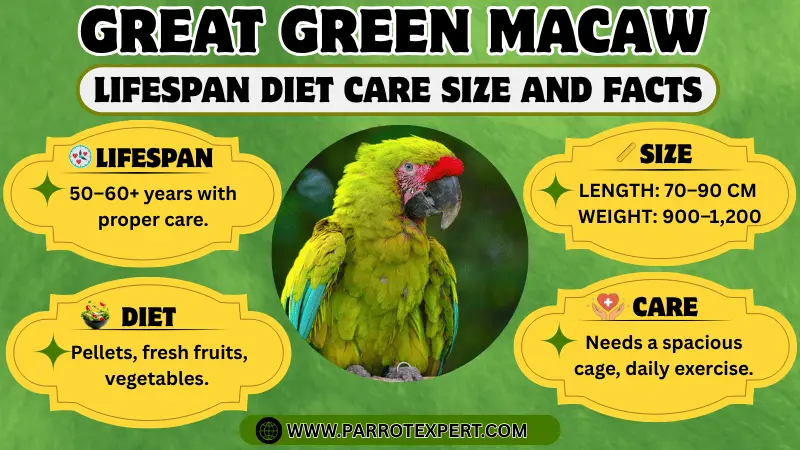
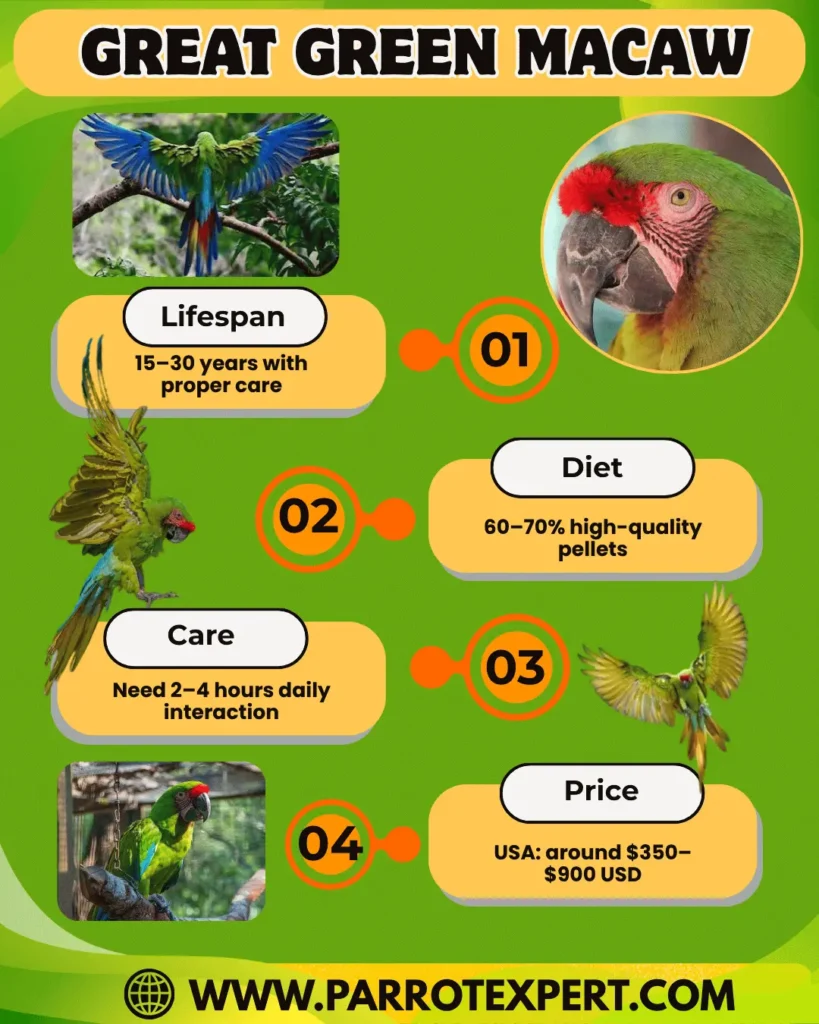
Great Green Macaws can live for years. Their life span depends on their genes what they eat, where they live and how well they are care for by a doctor who works with animals. Birds that live in the wild might have dangers because of animals that want to hurt them and because their home is disappearing.
Read More: Blue and Yellow Macaw: Lifespan, Diet, Care, Price, & Facts
Birds that live in a cage can sometimes live longer if they are given good care and however, responsible ownership requires a long-term commitment and planning. Anyone considering macaw ownership should understand this commitment thoroughly. A macaw may remain part of your family decades.
Great Green Macaw Size
The Great Green Macaw ranks among the largest parrots. Adults can reach impressive lengths from beak through tail. Their long tail contributes significantly to their overall body length. Most individuals measure around 85 to 90 centimetres long. Their wings also provide substantial surface area during flight.
However, individual measurements can vary depending upon age and condition.Their strong bodies support climbing, feeding, and powerful flying movements. Therefore, they need considerable space when living under human care.
Diet & Care
Vibrant green macaws dine on different seeds, fruits, tough-shelled nuts, and blossoms. Their main source of food is the fruit from the Swamp Almond Tree (Dipteryx panamensis).Their large, robust beaks allow them to break open even the toughest nuts to access the seeds within.
Read More: How Long Do Macaws Live? Macaws Lifespan in Wild & Captivity
Place large chewable toys in the cage for the bird’s Pleasure and physical activity. For the necessity cleanliness, place an overhead mister that will make the bathing easier and enjoyable. Also, make sure, the food bowls and water bowls are clean and tidy.
Great Green Macaw Cage Requirements
I think a large macaw needs a spacious enclosure.The cage should allow wing stretching and movement. Strong perches made from safe natural materials work well. Toys should encourage chewing, climbing and thinking. Moreover, pet owners ought to frequently inspect toys for any damage.
Replace toys quickly to avoid accidental injuries. Access to clean water should be ensure during theday.The enclosure should also receive regular cleaning and maintenance.
Great Green Macaw Breeding
Great Green Macaws usually form strong breeding pair relationships. They often depend upon large mature trees for nesting. Natural cavities provide suitable spaces for raising their chicks.
Read More: Cuban Macaw: Lifespan, Size, Extinct, Sale, and Facts
The female usually lays a small clutch of eggs. Both parents contribute significantly to raising their young. The parents provide food and protection throughout development.
However, habitat loss can reduce suitable nesting opportunities considerably. Therefore, protecting old-growth trees supports successful natural breeding.
Great Green Macaw Conservation Status
The Great Green Macaw faces serious conservation challenges today. Habitat destruction represents one of its biggest threats. We notice that illegal wildlife capture can also hurt wildlife and wild populations. You see that logging cuts down trees that wildlife need, for feeding and nesting. I understand that agricultural expansion splits forest habitats that’re key for wildlife.
Read More: Can Macaws Talk? Exploring Macaw Vocalizations
We think conservation organizations work to protect forests and wildlife populations. You know they also help with restoration and community conservation programs. so, we understand that safeguarding trees can significantly support macaw survival. Therefore, forest conservation remains essential for this species’ future.
Great Green Macaw vs. Military Macaw
| Great Green Macaw | Military Macaw |
| The Great Green Macaw looks similar to other large macaws. | However, it has several noticeable differences from Military Macaws. |
| Great Green Macaws generally show brighter green overall plumage | Military Macaws often display darker green body coloration. |
| The Great Green Macaw also has specific Central American populations. | Military Macaws are found throughout a larger area in Latin America. |
| Both species require considerable care and environmental protection. | Therefore, conservation remains important for both impressive macaw species. |
Common Health Problems
The great green macaw is susceptible to several health issues. Proventricular dilatation, referred to as macaw wasting disease, is a viral infection impacting the nervous system. Signs include appetite loss, weakness, weight loss, and head tremors. This condition has no available cure. The signs are treat with supportive care.
Read More: Military Macaw: Lifespan, Size, Diet, Care, Price, & Facts
Psittacosis is a disease. Psittacosis can transfer from birds to people. It is essential to be aware of Psittacosis Beak malocclusion, also known as “scissor beak” happens when the top and bottom beak don’t line up correctly causing a shape. If your macaw shows any signs of sickness or unusual behaviour it’s time to take them to the vet.
FAQs (Frequently Asked Questions)
Verdict Up
The great green macaw is a brightly-colored, beautiful bird that is threatened with extinction due to the loss of their habitat and the illegal pet trade.
Read More: Hyacinth Macaw Parrot: Species, Size, Lifespan, Diet, and Facts
While you may be able to find one of these birds that have been bred in captivity, it requires plenty of space, time, patience, and love to kept them as a pet. Knowing the bird’s requirements for exercise, diet, and play will help you give your macaw a happy and loving home.
If this article is valuable for you, then please share it along with your friends, family members, pet lovers or relatives over social media platforms like as Facebook, Instagram, LinkedIn, Twitter, and more.
Do you have any experience, tips, tricks, or query regarding on this? You can drop a comment!
Have a Nice Day!