The Green Winged Macaw is the species of parrots that exist. It can rise up to 36 inches in length. The Green Winged Macaw has an appearance and a strong personality. The Green Winged Macaw is known for mortal very social and for enjoying interaction. These traits make the Green Winged Macaw a popular pet.
Many people call the Green Winged Macaw a giant. The Green Winged Macaw is usually calm and patient, with people. The Green Winged Macaw shows qualities that capture the interest of many.
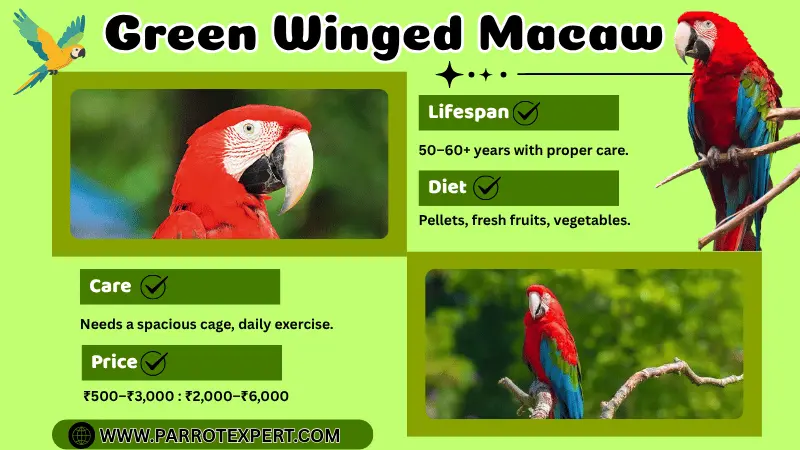
Below you will find all the information you should know about the Green Winged Macaw.
Green Wing Macaw Bird Facts
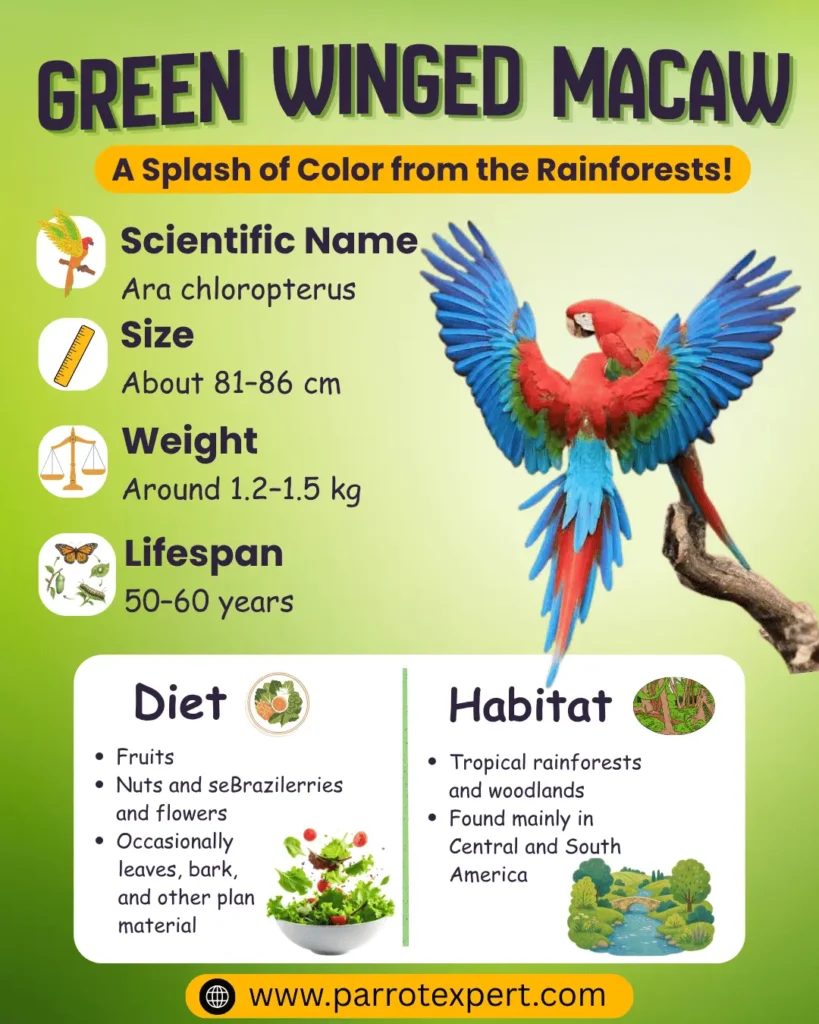
| Folk name | Green-Winged Macaw |
| In Latin | Ara Cloropterus (Periodically Ara Chloroptera) |
| Length | 95 cm / 37inc |
| Weight | 1100 – 1300g |
| Existence | above 60 years |
| Origin | South America |
| Noise Level | LOUD |
Origin and History
The Green‑Winged Macaw naturally survives in tropical lowland forests through Central and South America, forests such as Panama, Colombia, Venezuela, Ecuador, Guyana, Brazil, Peru, Suriname, French Guiana, Paraguay, Argentina and Bolivia. They share their home range with the and-gold Macaw.
Also Read: Blue and Yellow Macaw: Lifespan, Diet, Care, Price, & Facts
People have kept Green‑Winged Macaws in captivity since the century. Breeding in the wild was started in the century and has worked well. Nowadays it is easy to find Green‑Winged Macaws that raised in captivity. However many Green‑Winged Macaws still lose their homes and some are taken for the illegal parrot trade.
Green Winged Macaw Bird’s Personality
If you have never met a parrot a Green‑Winged Macaw may seem scary at first. The Green‑Winged Macaw has a strong beak but do not worry. The Green‑Winged Macaw is known as a giant. A Green‑Winged Macaw that has been socialised will not bite, although it may like to touch your fingers with its tongue. The Green‑Winged Macaw loves to hang out receive head scratches and take part in training.
Also Read: How Long Do Macaws Live? Macaws Lifespan in Wild & Captivity
The Green‑Winged Macaw is a bit more extroverted than some macaws and can be a very devoted pet. The Green‑Winged Macaw is also one of the ingenious in its group so it learns tricks quickly. The Green‑Winged Macaw also loves to celebrate. Music, playtime and the chance to scream loud are the Green‑Winged Macaw’s idea of an afternoon with its owner.
The Green‑Winged Macaw adapts quickly to a home and soon becomes a very loving member of the family.
Green‑Winged Macaw Speech and Vocalizations
The Green‑Winged Macaw can learn to say up to 15 words. It is not famous for talking. The Green‑Winged Macaw may. Scream when it feels excited threatened or wants attention. The Green‑Winged Macaw is very loud. The Green‑Winged Macaw is not a choice for people who live in an apartment or other small spaces.
If the Green‑Winged Macaw receives care it will scream sometimes loudly but not all the time. An unhappy Green‑Winged Macaw can make a lot of noise. May cause someone to leave their apartment.
Green Winged Macaw Lifestyle
The Green‑Winged Macaw is active during the day. Enjoys with other birds. The Green‑Winged Macaw typically stays in pairs or small groups. Sometimes it gathers in larger numbers at clay licks or feeding sites. During the season Green‑Winged Macaws defend their nests against predators and other birds. The Green‑Winged Macaw also moves to places when food changes.
Also Read: Cuban Macaw: Lifespan, Size, Extinct, Sale, and Facts
The Green‑Winged Macaw makes harsh calls, similar to other big macaws. When flying the Green‑Winged Macaw’s calls are very sharp. When it sits on a perch the Green‑Winged Macaw makes softer and more varied sounds.
Green Winged Macaw’s Size
The Green‑Winged Macaw is a parrot that looks very strong. The Green‑Winged Macaw usually measures ninety centimetres (35 inches) from head to tail. The Green‑Winged Macaw’s wingspan can be 100 to 125 centimetres when the wings fully spread. The Green‑Winged Macaw typically weighs, between one thousand fifty and one thousand three hundred grams as an adult.
Green Winged Macaw Diet
The Green‑Winged Macaw’s diet changes with the season. Where it lives. The Green‑Winged Macaw mainly eats seeds, fruit pulp, whole fruit and flowers from plants with a special liking, for seeds. The Green‑Winged Macaw has also been seen eating clay at a clay lick.
The anatomy of the Green‑Winged Macaw perfectly adapts to its diet. The Green‑Winged Macaw’s strong bill works like a tool able to crack shells that a human could not break without a hammer.
Also Read: Hyacinth Macaw Parrot: Species, Size, Lifespan, Diet, and Facts
In addition the Green‑Winged Macaw has zygodactyl feet—two toes and two toes back—that act almost like hands. These feet let the Green‑Winged Macaw hold fruit securely while it pulls out the seed with its muscular tongue.
Green‑Winged Macaw V/S Scarlet Macaw
Green‑Winged Macaws and Scarlet Macaws share visual similarities. However, the wing patterns give a clue that sets them apart.Green‑Winged Macaws display green colour across their wings.
Scarlet Macaws are frequently identified by the blue colours, on their wings. Both species need a lot of space a lot of attention a lot of activities and specialised care. Because of this. Is suitable, for someone who wants a pet that’s easy to maintain.
Common Health Issues
Green‑Winged Macaws, like macaw species can get several diseases, including:
Periventricular dilation disease (also called macaw wasting disease) is a viral disease that causes digestive problems and neurological symptoms. It is usually fatal. The best way to prevent it is to keep the Green‑Winged Macaw from other birds that may carry the virus.
Psittacine beak‑and‑feather disease is caused by a type of virus known as circovirus. It destroys the cells of the feather and beak. Weakens the immune system of the Green‑Winged Macaw. It is usually fatal. The best prevention is to make sure the Green‑Winged Macaw has been properly quarantined before you buy it.
Also Read: Severe Macaw: Lifespan, Size, Care & Diet, Price, and All Facts
Psittacosis is a disease that causes breathing problems and eye discharge in the Green‑Winged Macaw. Stressed Green‑Winged Macaws are at risk. Prompt treatment with antibiotics can regularly cure the disease. However Green‑Winged Macaws may also experience allergies and behaviour issues such, as feather plucking. Feather plucking usually happens when the Green‑Winged Macaw is getting bore or frustrate.
Green‑Winged Macaw Caring Tips
The average Green‑Winged Macaw is very social and likes to spend its life with least one other Green‑Winged Macaw. However a Green‑Winged Macaw can live happily alone if it receives socialisation, interaction and attention from its companion. When a Green‑Winged Macaw is bored it regularly destroys things so spending plenty of time with others is essential.
Green‑Winged Macaws need a cage that’s at least 3 feet by 3 feet for most of their time. This is the size. The cage the happier the Green‑Winged Macaw will become over time. Green‑Winged Macaws can live outside when the weather is warm. They also do well inside year‑round. The Green‑Winged Macaw should have a perch both inside and outside its cage.
The Green‑Winged Macaw’s cage should have branches and swings for exercise well as mirrors and wooden blocks for play. If the Green‑Winged Macaw lives indoors it is an idea to set up a “bird room,” where the Green‑Winged Macaw can roam freely and safely for an hour or two during the day.
Green‑Winged Macaw Price/ Sale
Green-Winged Macaws in India may cost anywhere, from ₹2.5 lakh to ₹5 lakh. Their price can vary depending on age, health, training, breeder and available documents. Humanize Text Prices vary by location and supply. Some breeders list rates. Regularly check the documents before buying a healthy well interacting Green‑Winged Macaw.
FAQs (Frequently Asked Questions)
Final Lines
These macaws are naturally social. They usually live in pairs or flocks. The love interaction. They enjoying be include in the family’s routine. Add their intelligence and one could say that owning a Green‑Winged Macaw is, like having a feathered toddler! Birds can be disorderly, loving, intelligent and very loud.
Also Read: Can Macaws Talk? Exploring Macaw Vocalizations
Because of these traits’ birds can become pets for owners who are dedicated, responsible and well-informed. The unique. Special needs that birds have make them rewarding companions. However birds are not a choice for beginner’s people, with young children or apartment dwellers.
If this article is valuable for you, then please share it along with your friends, family members, pet lovers or relatives over social media platforms like as Facebook, Instagram, Linked In, Twitter, and more.
Do you have any experience, tips, tricks, or query regarding on this? You can drop a comment!
Have a Nice Day!