Do you want to know about biggest goofballs in the pet parrot world? So, this is well-known as Gang-Gang Cockatoo. The naughty Gang-Gang is originally found in Australia’s cooler and wetter forests and woodlands.
This is a special and attractive bird is small and strong parrot. These parrots are mainly slate gray in color.
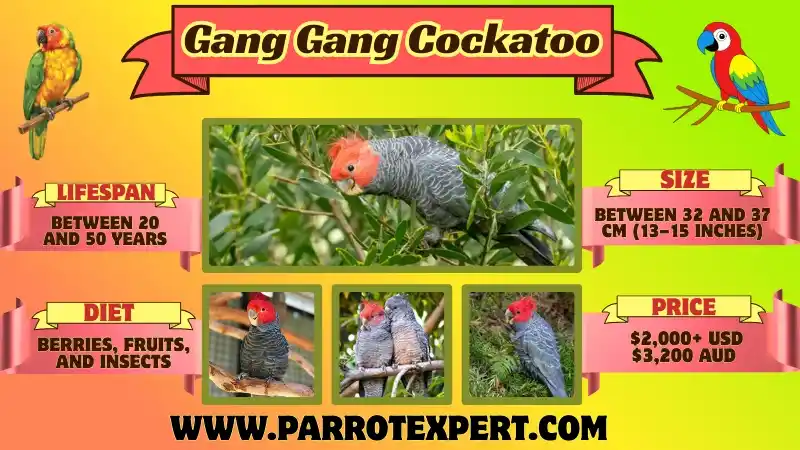
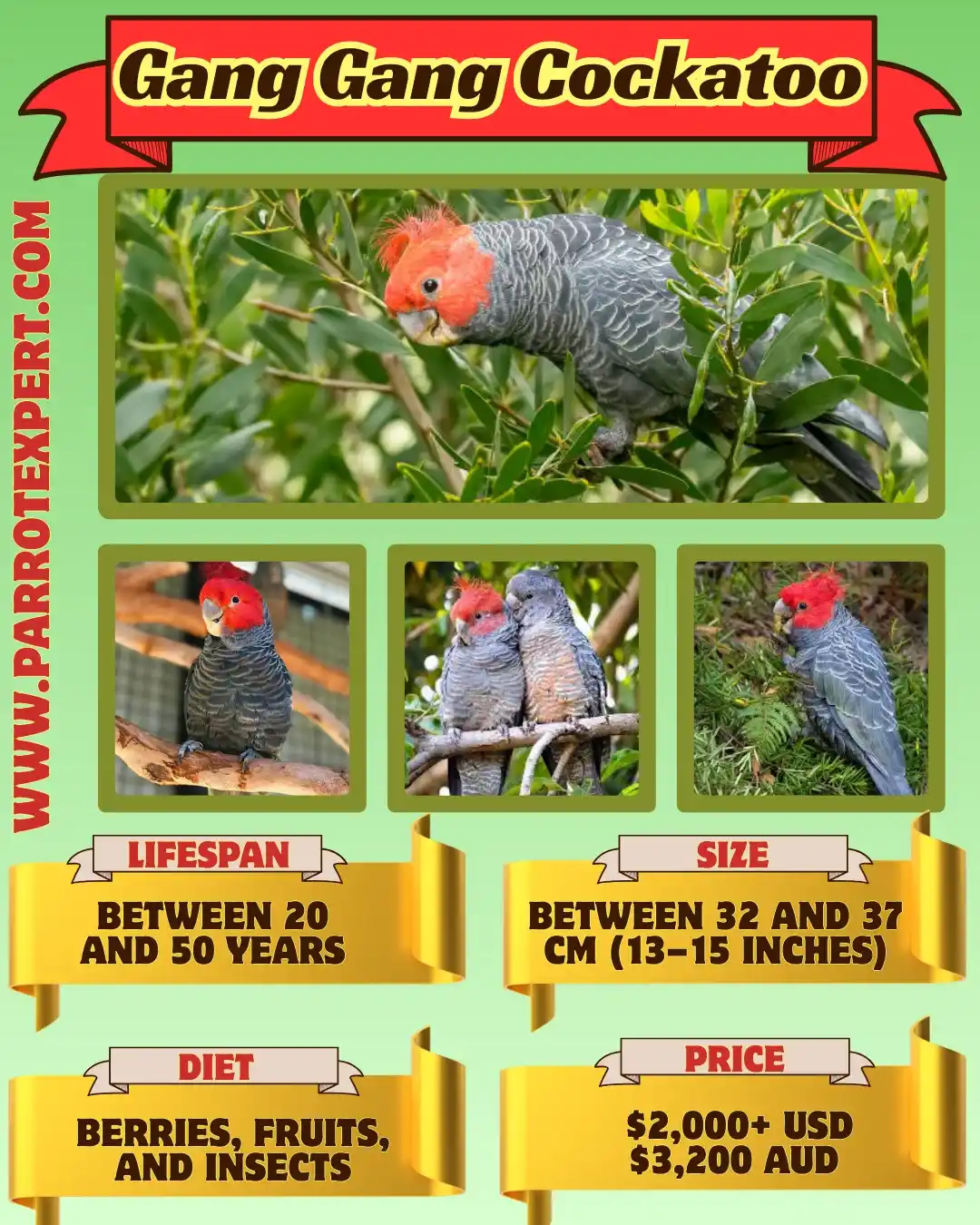
Male parrots can be easily recognizing by their bright red “helmet” and a fluffy crest. The females are commonly in gray having the feathers edges in pink on their bellies.
Gang Gang Cockatoo – Overview
| Scientific name | Callocephalon fimbriatum |
| Size | About 32–35 cm long |
| Weight | Around 230–260 grams |
| Lifespan | Up to 40 years in the wild |
| Habitat | Forests, woodlands, urban gardens |
| Range | South eastern Australia |
| Diet | Seeds, berries, fruits, insects |
| Male appearance | Red head and crest |
| Female appearance | Grey head with yellow markings |
| Conservation status | Least Concern (nationally) |
Gang Gang Cockatoo Origin & History
At one time this bird found in King Island of Tasmania but has gone extinct from there. Now the Gang-Gang is habitat in southeastern Australia and becomes the native to this region. The Gang-Gang is an introduced species on Kangaroo Island.
Also Read: Citron Crested Cockatoo and its Lifespan, Care, Diet, Size, & Facts
This bird gets his name from the reference to its long harsh call that sounds like a hinge of rusty door or the twist of a corkscrew. This rare name Gang-Gang originated from a New South Wales Aboriginal language.
The Gang-Gang is really a beautiful and special bird that using as a symbol for Australian Capital Territory (ACT). It is also part of the Canberra Ornithologists Group and ACT Parks symbols.
Gang Gang Cockatoo Physical Appearance
The Gang-Gang Cockatoo has a special type of appearance that characterized by its plumage in gray and red-pink. Male and female Gang-gang Cockatoos has similar physical features.
They have a curved salmon-colored beak, dark eyes and featherless red face patches. Although the most noticeable feature that makes it unique and captivating presence its ability to raise and lower its head crests.
Gang Gang Cockatoo Breeding Behaviours
Gang-gang Cockatoos are paired only with one for whole life and form strong bonds. They built their nests usually near water in large eucalypt trees’ hollow in a trunk or limb.
Also Read: Red Tailed Black Cockatoo and its Price, Lifespan, Diet, Size, & Facts
Male and female both prepare the nest together before laying by chewing on the sides of the hollow. They use the chips and fragments of wood to line their nest. They also share the duties of incubation and care for the young.
Breeding season: They usually breed usually October to January
Clutch size: Mostly two white eggs and sometimes its three.
Time to independence: Young birds will be fed by the parents until 6 weeks once they have fledged.
Gang Gang Cockatoo Sound
The Gang-Gang likes to make noise and it is a talkative bird. Although Gang-Gang is not as intense if compared to other cockatoos that are very loud and rough.
This cockatoo has a unique call that sounds like a creaky door being opened. If they get trained Gang-Gang can learn some basic sounds and repeat short phrases which typically include their name.
People who have Gang-Gang Cockatoo know that they love being spoken and enjoy all the attention. The Gang-Gang Cockatoo is a bird that likes the sounds and talking.
Gang Gang Cockatoo Vs Galah
Gang-gang cockatoos and galahs are both habitat in Australia. But both are different in looks and behavior. Gang-gang cockatoo’s males are in come gray color along with special red heads.
Also Read: Black Palm Cockatoo and its Lifespan, Size, Diet, Price/Sale, & Facts
And, these parrots mostly found in forests and woodlands. They are quiet and shy than Galah. Galahs are very common in pink and grey color. They are highly social and thrive in open grassland, farms and cities.
Galahs mostly eat on the ground for grass and grains. On the other hand Gang-Gang eats seeds, berries and insects in trees. Galahs can be usually seeing in small groups or pairs and makes large noisy flocks.
Gang Gang Cockatoo Male and Female
It is easy to tell apart about male and female gang-gang cockatoos. Males have a bright red head and crest, grey body and short tail gives them a unique appearance.
Females have less red color on head but have a grey head with pale feathers on edges. They also faint yellow stripes on their chest and wings.
Even females have a little long tail with some markings underneath. Male and female both are medium in size and they share similar sounds and behavior.
They usually eat seeds, berries and insects in forests and woodlands of southeastern Australia.
Gang Gang Cockatoo Diet & Feeding
There are many different kinds of diet for Gang-Gang. As they loves to eat seeds and fruits mainly. Still they like to eat flowers, nectar and insects sometimes.
The Gang-gang Cockatoo get the necessary nutrients from seeds and fruits for their survival. To consume a wide range of seeds and fruits that are available in their habitat these intelligent birds have developed specialized beaks and chewing abilities.
The gang Cockatoo supplements its diet with other sources in addition to seeds and fruits. They also find and collect the nectar from the flowers that is not only provides them a sweet treat but also serve as an additional source of energy.
Moreover the Gang-Gang Cockatoo are also carnivorous and they capture insects as part of its foraging behavior. It helps them to get protein and other essential nutrients that it may not get from the seeds and fruits.
The Gang-Gang Cockatoo usually looks for their food in small flocks and moving through treetops. This group behavior makes them to feel safe and cooperative during the food searching. It also helps them to cover a large area to find the food from different sources.
Gang Gang Cockatoo Health Issues
If Gang-Gang cockatoos get the stress then they can behave such as feather picking and self-mutilation like other cockatoos. There are some other common health issues these birds face like psittacine beak disease that’s a virus and attacks the bird’s immune system.
Also Read: Yellow Tailed Black Cockatoo: Lifespan, Diet, Habitat, Size, & Facts
They also have another problem that Gang-Gang get developing a painful lesions on their feet is called Bumblefoot. When they live in cage most the time and don’t get enough physical activity that may cause of the obesity in birds.
Always keep eye closed be carefully your bird’s health issues or any symptoms of illness to keep them as well-being. But, Gang-Gang cockatoo don’t feel well in captivity; or they get easily stress.
A stressed Gang-Gang are more likely to get a disease and that makes them to pull out its own feathers or sometimes it can pluck another bird’s feathers also.
Gang-Gang Cockatoo Caring Tips
The cage of a Gang-Gang Cockatoo should be very strong and made of iron or steel that can stand up to this bird’s powerful beak. The cage should be about 36”W X 24” D 48” that required not smaller than it.
So, it has enough space to move and play around. The Gang-Gang needs around 10–12 hours to sleep in a day as they are very active during the day.
This bird is very active and playful that it requires the toys in its cage to play. If you want to keep your bird stress free gives them enough time and attention. Otherwise they start plucking feathers when they get boring.
Keep away your other pets like cats and dogs from Gang-gang’s cage and small children also if you are not there to watch them.
When Gang-Gangs clean their feathers they produce the feather dust like other cockatoos. This fine dust can spread throughout your home and becomes the reason of allergies in some people while it is useful to the bird.
Gang-Gang likes to live in groups and with another bird. You have to get a pair if you are interesting in this bird. In case you already have a Gang-Gang and you want to have another one then make sure you introduce them slowly.
It is good to keep separate these birds in starting in their own cages. Keep their cages next to each other so the birds can get using to each other before they start living together.
Gang-Gang Cockatoo – Facts
Gang-Gang are usually located in trees that the source of their food and can find easily by the sound of falling debris and feeding. They are very friendly and also quiet cockatoos.
Also Read: Slender Billed Cockatoo and its Lifespan, Diet, Care, Price, & Facts
As it is mentioned that the name ‘Gang-Gang’ comes from a Aboriginal language of New South Wales. It is most likely a coastal language. Although possibly from Wiradjuri.
While a Gang-Gang cockatoo eating it holds the piece of fruit with one foot to open it with its beak. They uses their lower mandible and tongue to take out the seeds.
Gang-Gangs usually like to chew everything and they need the toys and activities to make their selves busy.
If they get bored, stressed and don’t get enough attention then they start plucking feathers.
FAQs (Frequently Asked Questions)
Are Gang Gang Cockatoos Rare?
Gang-gang cockatoos are not extremely rare but they become uncommon and declining in parts of Australia. Due to habitat loss they start to move near cities and forests.
Are Gang Gang Cockatoos Endangered?
Gang-gang cockatoos are not officially endangered but there are some regional populations are risked and decreasing due to habitat loss, bushfires and climate changes.
What Do Gang Gang Cockatoos Eat?
As we discussed that gang-gang cockatoos mainly eat seeds, berries, nuts, fruits and insects. They basically eat from eucalyptus, acacia and native shrubs. They use their strong beak to crack hard shells.
How Much Do Galah Cockatoos Price/Cost?
As a pet the Galah cockatoos can cost quite a bit depending on country, breeder, age and legality but often it is around $700–$3,000 USD (~₹60,000–₹250,000) with some listings higher or lower. Before going to buy them you have to always check local laws and welfare requirements.
Bottom Lines
At the final, Gang-gang Cockatoo comes in the variety of Australian birdlife along with its unique appearance. This bird is an important part of the country’s natural environment as a native to southeastern Australia. It looks unique and eye catching by its iconic crest and vibrant plumage.
Also Read: Long Billed Corella and its Lifespan, Diet, Care, and Facts
The Gang-Gang Cockatoo is important for both in nature and culture. It is one of the Australia’s most unique birds. It is showing its cultural value appears in Aboriginal stories and artworks.
This is marked as a symbol of Australia has also been featured on Australian postage stamps. Overall it is an iconic bird of Australia.
Do you have any experience, tips, tricks, or query regarding this issue? You can drop a comment Facebook, Instagram or just here!
Have a Nice Day!