You guys wondering to know about mini parrots. Would you like to think about a strange species of parrot that tiny in size but not in personality? So no one is better than the Amazonian parrotlet bird. These species is so adorable and charming. That’s wins the hearts of the audience.
That’s why they are known as “big bird in small physic”, these tiny parrots are so incredible. They are so intelligent and also very loveable by their nature.
They are not just the birds found only in the South American rainforest. Amazonian Parrotlet identify their unique personality so attract the nature and attracts the parrot lovers.
Amazonian Parrotlets Facts
| Fact | Details |
| Scientific Name | Nannopsittaca dachilleae |
| Family | They are belongs to Psittacidae (true parrot) family |
| Native Habitat | Western Amazon Basin in countries like Brazil, Peru, and Colombia |
| Size | Around 14 cm (5.5 inches) in length |
| Weight | Around 30–35 grams |
| Coloration | Mostly green plumage with subtle darker markings |
| Diet | Firstly seeds, fruits, berries, and vegetation |
| Social Behavior | Many times seen in small flocks; social and active birds |
| Conservation Status | Listed as Least care by IUCN (but habitat loss is a concern) |
| Unique Trait | One of the smallest Amazon region parrots; relatively shy and less studied compared to larger Amazon parrots |
What Is Amazonian Parrotlet?
Amazon parrots have soiled body. These small parrots are 14 cm to 15 cm or 5 to 6 inches in length. Personality wise they have beautiful green plumage, their Cheeks, chin Breast and abdomen are low green or yellowish- green in color.
Also Read: Mexican Parrotlet and its Lifespan, Habitat, Care, Diet, & Facts
And also it has contained power blue color in lores and forehead area. They also have ear-covered fathers in brownish color.
The shoulders and back of Amazon parrots are dark brown color. The lower back is brownish-black. The sides of the body are a pale bluish-grey.
These adorable parrots have tiny red stain in their wings. Their primary –wings converts brown with greenish color. They have black fathers with green outer vanes on their body. OR Under wings area are occurs bluish- green color.
In their mid tail-feathers has green color with black spots; whereas the outer tail-feather has red color with black spots. These are some of identity of Amazonian Parrotlet. The ring round of eyes is slightly in white color.
Amazonian Parrotlet Behavior
Now, we talk about the exact number of Amazonian parrotlet flocks is not correctly known. But scientists believe that they consist of 10 to 20 birds. It can also be expressing in this way that these birds regular found sitting on tall trees in front of Altamira Beach. This is located about 25 minutes from Manu Resort. At the alarm call of any one in the flock, the entire group quickly flies away and disappears from sight.
It can also be expressing in this way that the habitat of the Amazonian parrotlet is shared with other parrot species. Its presence alone is rarely recorded; more often it can be seeing with larger parrots. Gathering of various flocks in the morning in search of food is its usual activity (Gillard J.D., Mun C.A., 1998).
In other words, the study showed that smaller parrots move in groups of limited numbers. But, larger birds form relatively bigger flocks as comparing this with the findings of O’Neil and colleagues. It can be inferring that the social and breeding behavior of Amazonian parrotlets that unique compared to other smaller birds.
Amazonian Parrotlet Distribution & Habitat
As we know the forests of Peru are the basis for the reality of the Amazonian Parrotlet. This bird avoids open areas and stays safe only in dense forest regions. As food, it mostly depends on the seeds of Guadua bamboo.
Also Read: Celestial Parrotlet and its Lifespan, Size, Color, Diet, & Facts
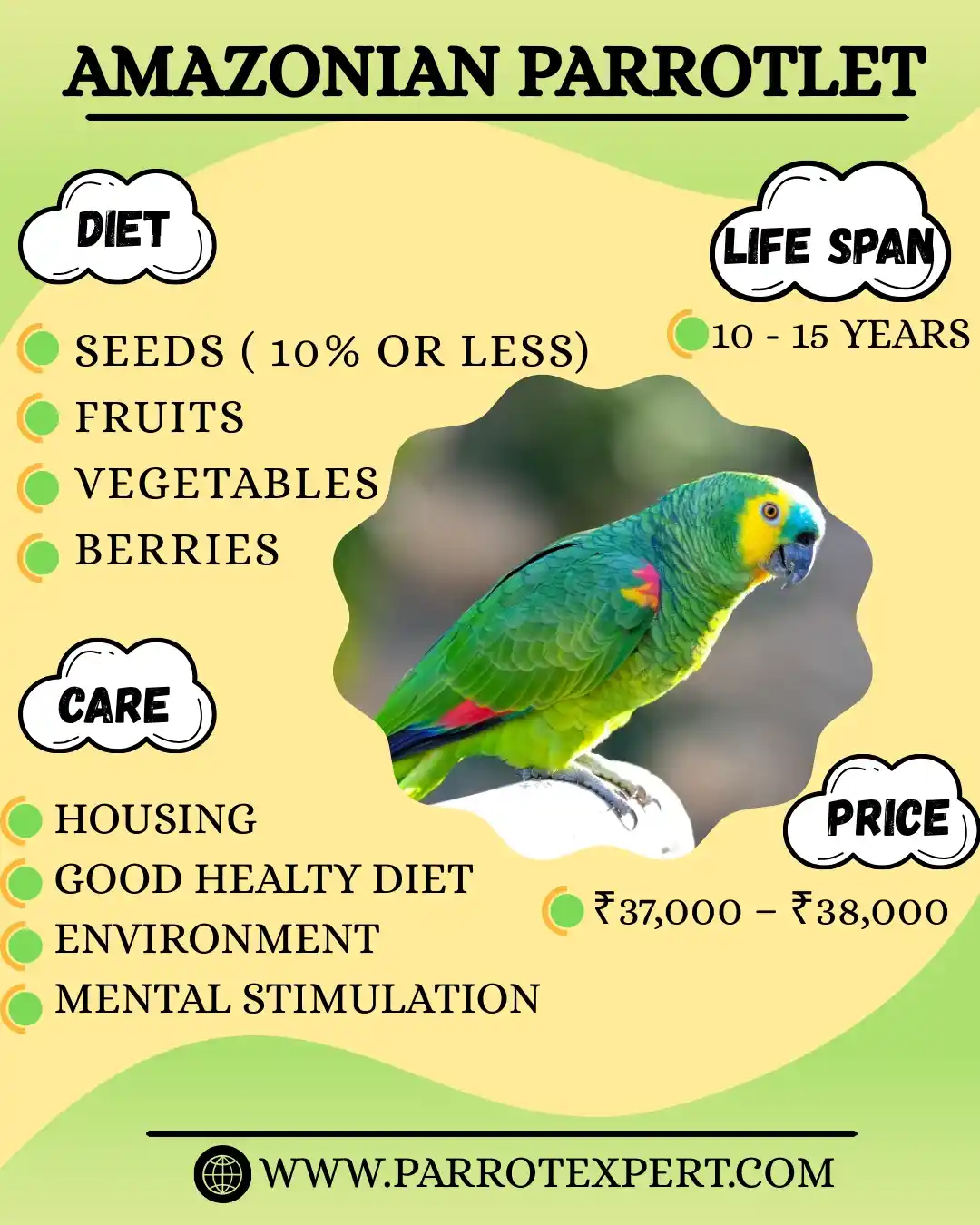
Let us discuss Guadua bamboo not only gives food but also offers a safe place for birds to hide and build nests due to its dense structure. The vast and safe forest area of Manuel National Park gives these birds with a stable and secure environment.
Amazonian Parrotlet Diet and Nutrition
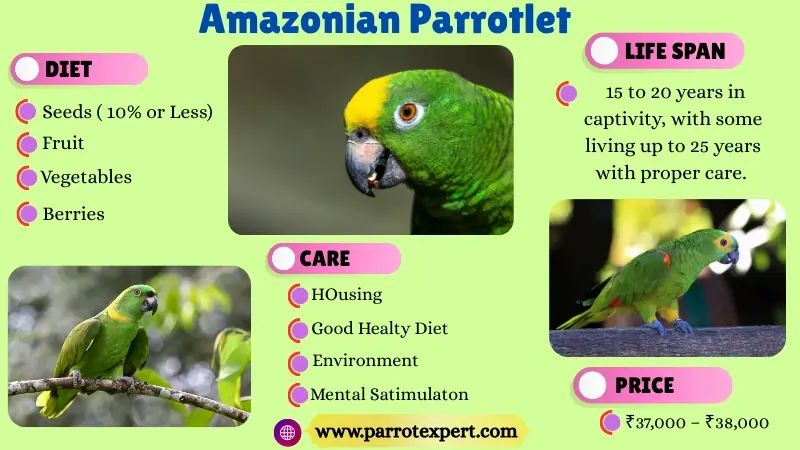
If you want Amazonian parrot to stay healthy, then should give it the right food. A proper diet should have:
High-Quality Pellets (60-70%): These form a healthy base like your bird’s diet. Start launches them while your bird is still young.
Fresh Fruits and Vegetables (20-30%): You can provide in our bird fresh fruits and vegetables daily. Good choices for them are leafy greens, carrots, bell peppers, and melon.
Limited Seeds (10% or less): As another option of providing them as the main diet. So, you can offer them the sprouted seeds as a healthy addition treat.
Foods to Avoid: Must be avoiding some foods that are bad for parrot like avocado, chocolate, & caffeine. It’s also avoided salty, sugary, and fatty foods.
Amazonian Parrotlet Vocalizations & Communication
In simple terms; Amazonian parrotlets are calmer as comparing to larger parrots that making them easier to keep in an apartment. Their voices include light chirping and occasionally loud sounds, and the males talk more than the females.
But, these species are not very talkative; some birds can still learn a few words or short phrases, which are often in a high and rough voice.
Amazonian Parrotlet Health Issues
In simple words we are explaining the Amazonian parrotlets can also get sick. Few common health problems are as follows:
Also Read: Spectacled Parrotlet and its Facts, Diet, Care, and Habitat
Nutritional Deficiencies: Mostly, seeds haven’t sufficient vitamin A and calcium. Therefore, this may damage the bird’s lungs, immunity, and bones?
Respiratory Infections: In this many symptoms get involving the sneezing, nasal discharge, breathing, or wheezing. The starting point is many time germs involve the bacteria, fungi, and viruses.
Feather Disorders: The feather problem can show as removing from stress or parasites.
Avian Polyomavirus: A serious viral disease especially in young birds. Vaccinations are available in some regions.
Psittacosis (Chlamydiosis): This disease transfer to humans. Its create respiratory and digestive problem.
PBFD (Psittacine Beak and Feather Disease): A virus that harms the feathers and beak.
Injuries: As we know these parrots are small and very active. They can easily get injuries by falling, hitting or getting stuck in small spaces.
Amazonian Parrotlet Grooming Essentials
In simpler words; grooming your parrot daily that helps it stay healthy and feel good.
Nail Trimming: In simple terms long nails can get create injury. Your bird doctor can trim them a safe method. Proper perching slowly wears down the nails.
Wing Clipping (Optional): As we know wing clipping is a way to ensure safety for some people; while others consider it important. It should always be doing by an experienced person and it is not permanent wings grow back.
Bathing: In easy words small parrots like to bath daily. It’s give them warm water. This keeps their feathers clean and their skin healthy.
Summing Up
In conclusion, Amazonian parrotlets have a big heart and a good personality in a small size.
Also Read: Pacific Parrotlet and its Lifespan, Size, Color, Diet, Price, & Facts
Their curious, adventurous nature and beautiful blue markings make them special. We have giving detailed information about their natural life, important facts, daily care, and their unique behaviors.
Do you have any experience, tips, tricks, or query regarding this issue? You can drop a comment Facebook, Instagram or just here!
Have a Nice Day!